

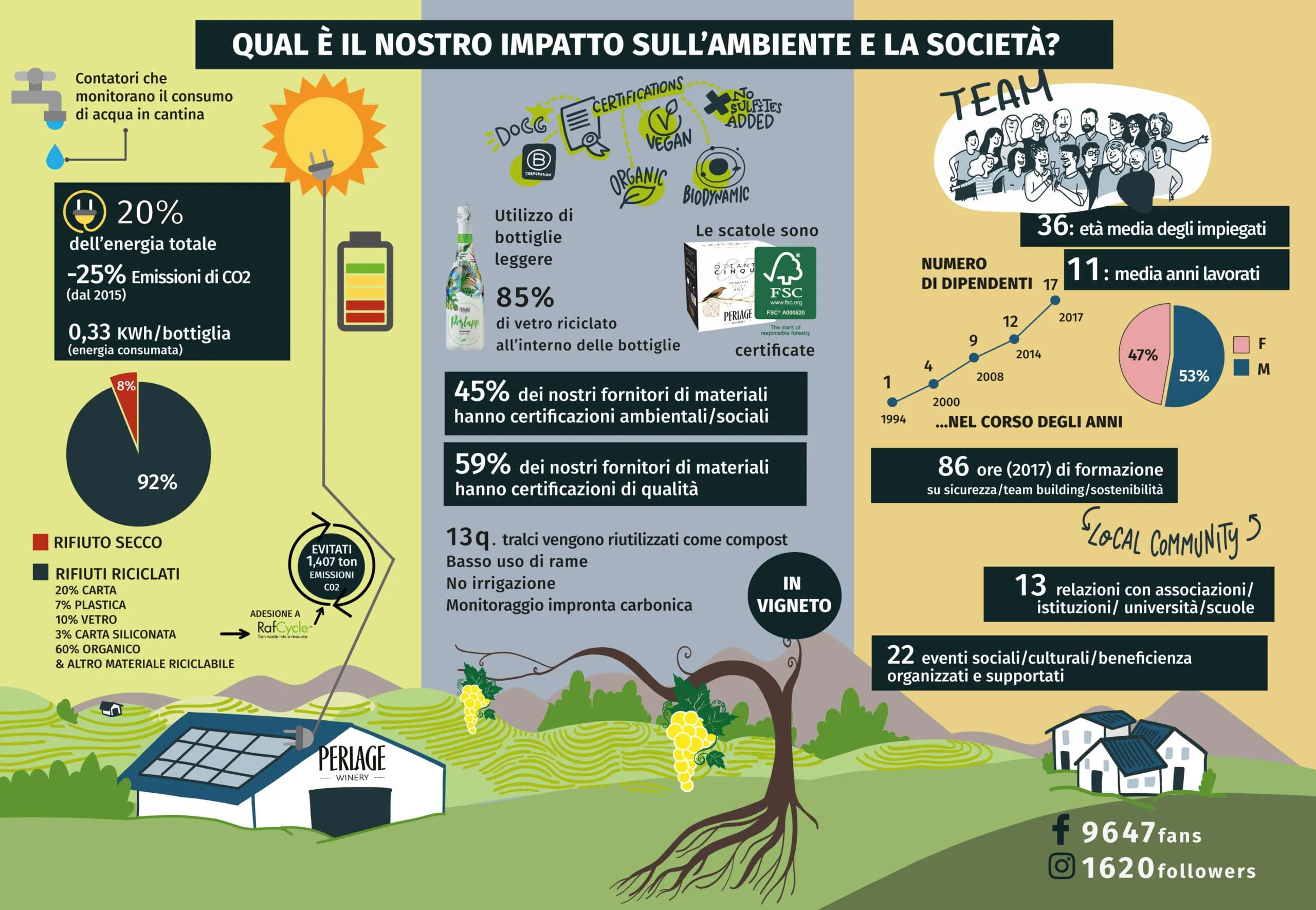
December 2018: Perlage publishes its first social report, consciously embarking on a path of non-financial reporting.
Traditionally, it has been customary to refer to financial statements exclusively in economic terms, in the sense of reporting, annually, the company’s financial, asset and economic data. However, it is evident how a company, today, in everyday reality, does not play an exclusively economic role, but also a social one. This is, moreover, one of the pillars of Corporate Social Responsibility.
But more exactly, what does it mean to draw up “a social budget”? Why should each company be spurred to do so?
Making a social report means reporting externally about the impact the company has on its Stakeholders, Society, and especially the Environment.
And what are the stakeholders? The latter play a fundamental role in the social report, since they are all those stakeholders with whom the company interfaces in its daily work, employees, customers, suppliers, public administration, shareholders, consumers, the environment… Each stakeholder may have a certain level of interest and influence on the company.
That is why it is important to identify key or strategic stakeholders; that is why it is necessary to involve them in business processes (from product selection to events).
The company gets directly in touch with stakeholders, so as to put them in a position to offer feedback on the company’s operations. In fact, we could also call the social report a “Stakeholder Report.”
Transparency and accountability (accountability) not only financially but also socially and environmentally. In practice we give evidence of how the money from the company’s profit is used for the identified key stakeholders.
What are the benefits? The social report is an opportunity for discussion and involvement of its stakeholders, collection of useful elements to focus the company’s mission, promotion of internal/external communication and transparency of the company.